A realistic, step-by-step guide using smart risk management, proven strategies, and the discipline that actually works no hype, no false promises.

5%
Max Risk/Trade
10×
Growth Target
2–3
Daily Trades
80%
Avg Payout
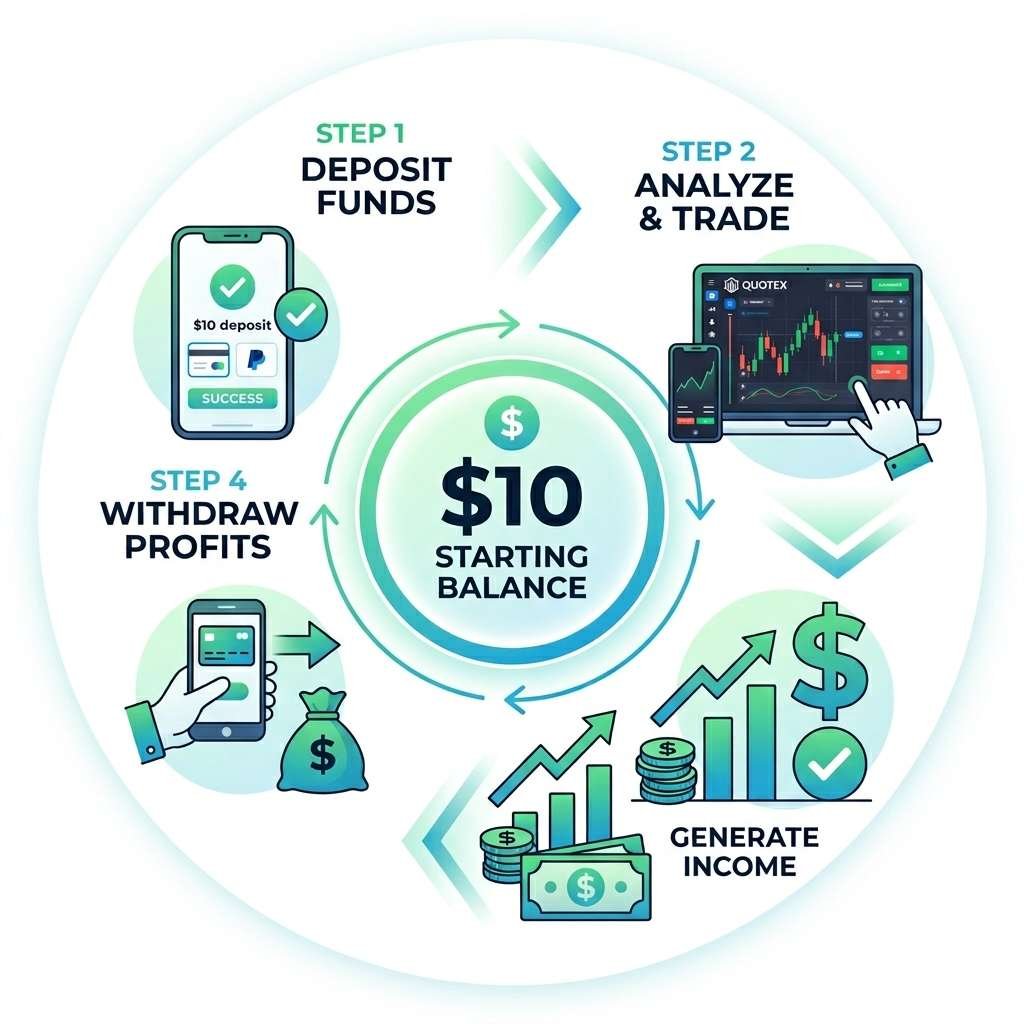
Starting with $10 and growing it to $100. That’s a 10× return. Sounds exciting, right? But let’s be honest. The truth is, the Quotex 10 to 100 strategy is very much possible. Thousands of traders around the world start with small accounts and build them up over time.
The key word here is time. Not luck. Not shortcuts. What separates traders who grow their accounts from those who blow them up is simple: patience, strategy, and discipline. If you’re a beginner looking to learn how to trade on Quotex without gambling away your money, you’re in the right place.
This guide will walk you through everything you need to know — from basic concepts to a real trading plan. We’ll keep it simple, honest, and beginner-friendly. No flashy promises. Just real, actionable Quotex trading tips that work.
Can You Really Turn $10 into $100 on Quotex?
Let’s break it down honestly. To turn $10 into $100, you need to grow your account by 900%. That’s a big jump. But with the right Quotex strategy for beginners, it becomes a realistic goal when you spread it across many small, consistent wins.
Here’s what you need to understand:
- 📌 It won’t happen in a day. Realistic traders aim for steady growth, not overnight riches.
- 📌 You need multiple successful trades. Each trade is a small step not a lottery ticket.
- 📌 Risk is always involved. Even the best traders lose trades. The goal is to win more than you lose.
- 📌 Compounding is your friend. Reinvesting small profits helps your account grow faster over time.
How Quotex Trading Works
Before you start trading, you need to understand what Quotex actually is and how it works. This is the foundation of any Quotex strategy for beginners.
Quotex is a digital options trading platform. That means you’re not buying stocks or currencies directly. Instead, you’re making a prediction: will the price of an asset go UP or DOWN within a set time period?
Here’s how a basic trade works:
- You choose an asset (like EUR/USD or Gold).
- You choose a trade amount (e.g., $0.50 or $1).
- You choose a time frame (e.g., 1 minute, 5 minutes).
- You click UP (Call) or DOWN (Put).
- If you’re right, you earn a profit of 70%–95%. If you’re wrong, you lose your trade amount.
Trade durations can range from 30 seconds to several hours. As a beginner, longer time frames (1–5 minutes) are safer because they give you more time to analyze the market before the trade expires.
The Real Strategy to Grow $10 to $100
Now let’s get into the actual Quotex 10 to 100 strategy. This is broken into 5 clear steps that any beginner can follow.
Start with a Demo Account
Before you risk a single real dollar, practice on Quotex’s free demo account. The demo gives you virtual money to trade with real market conditions. This is where you learn without losing.
Spend at least 1–2 weeks on the demo account. Test different strategies. Get comfortable with the platform. Track your results. Only move to a real account when you’re consistently profitable on demo.
Use a Fixed Risk Per Trade (Very Important)
This is the most critical rule in any trading strategy: Never risk more than 5%–10% of your account on a single trade.
With a $10 account:
- 5% risk = $0.50 per trade
- =10% risk = $1.00 per trade
This protects your capital. Even if you lose 5 trades in a row, you still have money left to recover. Traders who risk 50%+ per trade can blow their entire account in just 2 bad trades.
Start with $0.50 per trade. Protect your $10 like it’s $10,000.
Follow the Trend (Simple Strategy)
One of the most powerful and simple strategies when learning how to trade on Quotex is trend following. The market moves in trends up, down, or sideways. Your job is to identify the trend and trade with it, not against it.
Use the Moving Average (MA) indicator:
- If the price is above the MA → trend is UP → take UP trades.
- If the price is below the MA → trend is DOWN → take DOWN trades.
It’s that simple. Don’t fight the trend. Most beginners lose because they try to predict reversals too early.
Use 1–2 Indicators Only
More indicators do NOT mean better trades. In fact, using too many indicators causes analysis paralysis — where you’re so confused by conflicting signals that you can’t make a decision.
As a beginner, stick to these two:
- RSI (Relative Strength Index): tells you if the market is overbought (above 70) or oversold (below 30). Great for spotting potential reversals.
- Support & Resistance Levels: horizontal lines where price tends to bounce. Great for timing your entries.
When the trend confirms + RSI gives a signal + price is at support or resistance = high-probability trade setup.
Trade Only High-Probability Setups
Not every candle is a trade opportunity. Beginners often overtrade, clicking UP or DOWN randomly, hoping to get lucky. That’s not trading. That’s gambling.
Instead, wait for confirmation. A high-probability setup means:
- The trend is clear (confirmed by MA).
- RSI supports the direction.
- Price is bouncing from support or resistance.
- No major news release in the next few minutes.
If even one condition is missing, skip the trade. There will always be another opportunity. Patience is a trading superpower.
Example Plan to Turn $10 into $100
Let’s look at a realistic growth projection using the Quotex 10 to 100 strategy with an 80% payout, $0.50 per trade, and a compounding approach. The plan assumes 2–3 successful net trades per day (after accounting for losses). This is very achievable with discipline.
| Day | Starting Balance | Trades Won (Net) | Profit Earned | Ending Balance |
|---|---|---|---|---|
| Day 1 | $10.00 | 3 | $1.20 | $11.20 |
| Day 3 | $11.20 | 3 | $1.35 | $12.55 |
| Day 5 | $12.55 | 3 | $1.50 | $14.05 |
| Day 8 | $14.05 | 3 | $1.68 | $15.73 |
| Day 12 | $18.50 | 3 | $2.22 | $20.72 |
| Day 18 | $28.00 | 3 | $3.36 | $31.36 |
| Day 25 | $45.00 | 3 | $5.40 | $50.40 |
| Day 32 | $72.00 | 3 | $8.64 | $80.64 |
| Day 38 | $88.00 | 3 | $10.56 | $98.56 ≈ $100 🎯 |
This table shows that compounding small wins consistently can realistically grow a $10 account to $100 in roughly 5–8 weeks. Some days will be better, some worse. The key is to stay consistent and never deviate from your risk rules.
Risk Management Rules (Most Important Section)
Common Mistakes Beginners Make
Most beginners make the same mistakes over and over. Knowing these in advance can save you a lot of money.
- Overtrading: Taking 20–30 trades per day hoping more trades = more profit. It doesn’t. More trades = more exposure to risk. Quality over quantity every time.
- Using Too Many Indicators: Putting 6–8 indicators on your chart creates confusion, not clarity. Stick to 1–2 indicators and learn them well.
- Chasing Losses (Revenge Trading): After a loss, doubling the next trade to “get it back” is called revenge trading. It almost always leads to bigger losses. Walk away instead.
- Ignoring the Trend: Trying to catch every reversal is risky. Most beginners lose because they fight the dominant trend. Follow the trend — it’s your biggest ally.
- Trading Without a Plan: Jumping into trades based on gut feeling or “signals” from strangers online is not a strategy. Always have a clear entry and exit plan before you click.
Pro Tips to Grow Faster
- Trade During High-Volatility Sessions: The best time to trade is during the London–New York overlap (1 PM–5 PM GMT). This is when markets move the most, giving clearer signals and better trade opportunities.
- Focus on 1–2 Assets Only: Don’t scatter your attention across 10 different assets. Pick one or two (like EUR/USD and Gold) and master their behavior. You’ll start to recognize patterns faster.
- Keep a Trading Journal: After every trading session, write down: what trades you took, why you took them, and what happened. This habit turns every loss into a lesson and every win into a repeatable system.
- Always Test Strategies on Demo First: Have a new idea? Test it on demo for at least a week before using real money. Your real account is not a testing ground it’s where you execute proven strategies.
Is This Strategy Safe?
Let’s be completely honest here. No trading strategy is 100% safe. Anyone who tells you otherwise is lying. Digital options trading carries inherent risk. You can and will lose trades. Some days you’ll lose more than you win. That’s normal. It happens to every trader beginner and professional alike.
What makes the Quotex 10 to 100 strategy as safe as possible is:
- ✅ Small, fixed risk per trade (5%–10%)
- ✅ Consistent strategy with clear entry rules
- ✅ Stopping after daily loss limits are hit
- ✅ Not trading with money you can’t afford to lose
Conclusion
Growing $10 to $100 on Quotex is a realistic goal but only if you treat it like a skill, not a slot machine. Start small. Learn the basics. Practice on demo. Manage your risk. Follow the trend. Stay patient. The traders who succeed aren’t the ones who got lucky once.
They’re the ones who showed up consistently, learned from their mistakes, and stayed disciplined even when it was hard. Use the Quotex 10 to 100 strategy outlined in this guide as your starting point. Focus on learning, not gambling. Celebrate small wins. Review your mistakes. Improve week by week.
Frequently Asked Questions
How long does it take to turn $10 into $100 on Quotex?
Realistically, it takes 4–10 weeks for disciplined beginners. Following a solid compounding strategy, expect 5–8 weeks, depending on consistency, win rate, and risk management.
Is Quotex good for beginners?
Yes, Quotex is beginner-friendly with a clean interface, demo account, low minimum deposit, small trade sizes, and a variety of assets. Education and practice remain essential.
What is the safest Quotex strategy for beginners?
The Trend-Following Strategy with risk management is safest. Use Moving Averages, RSI, support/resistance levels, risk 5% per trade, and stop after consecutive losses.
Can I lose all my money on Quotex?
Yes, reckless trading can lead to total loss. Proper risk management, small stakes, and stopping after losses greatly reduce this risk and protect your capital.