
A solid binary options trading strategy is the single biggest factor separating beginners who blow their first account from those who steadily build real skill. This guide covers every major strategy from RSI and MACD signals to price action, support and resistance, scalping, and trend following along with step-by-step entry rules, risk management, and the trading psychology that ties it all together. Before risking real money, you will also learn why choosing a regulated broker is non-negotiable in 2026.
What Are Binary Options?
A binary option is a fixed-payout financial contract. You predict whether the price of an asset a currency pair, commodity, index, or stock will be above or below a set level at a specific expiry time. If correct, you receive a fixed return (typically 70–90 % of your stake). If wrong, you lose the amount staked. There are only two outcomes: win or lose hence “binary.” Digital options work the same way but sometimes offer variable payout multipliers depending on how far the price moves.
Why Strategy Matters More Than Luck
Because every trade has a fixed worst-case loss, survival depends on your win rate and risk-reward ratio. A random coin-flip produces a ~50 % win rate — not enough to cover broker fees and generate profit. A structured strategy targets setups where probability tilts in your favour before you click a button.
Choosing a Regulated Platform: The Foundation of Every Strategy
No trading strategy can work if the platform is unfair, blocks withdrawals, or is illegal. Many popular binary options platforms, especially those shared on social media, have been warned or banned by regulators like the UK FCA, EU CySEC, and Australia’s ASIC.
What to Look For in a Regulated Broker
- Active licence from FCA (UK), CySEC (EU), ASIC (Australia), or CFTC/NADEX (USA)
- Segregated client funds held at a tier-1 bank
- Transparent payout percentages published before you trade
- Verified withdrawal history and responsive support
- A fully functional demo account for practice
Tip: Always verify a broker’s licence number directly on the regulator’s public register before depositing. A logo on a website proves nothing.
How to Trade Binary Options Step by Step
Follow this structured workflow on every trade whether you are on a demo account or live.
Choose Your Asset and Session

Stick to assets you understand. Major forex pairs (EUR/USD, GBP/USD) during the London or New York session offer the highest liquidity and the most reliable technical signals. Avoid exotic pairs and highly volatile commodities until you have 3–6 months of demo history.
Select Your Expiry Time

Expiry time is the single most overlooked variable for beginners. Short expiries (1–5 minutes) are high-noise and suit scalping strategies only. Longer expiries (15 minutes to 1 hour) reduce noise and give technical setups room to play out. Start with 15-minute expiries while learning.
Identify the Market Condition

Ask: Is this market trending or ranging? Trend-following strategies fail in sideways markets. Support and resistance strategies fail in strong trends. Matching the right strategy to the right market condition is the core skill of profitable trading.
Apply Your Strategy Rules (No Exceptions)
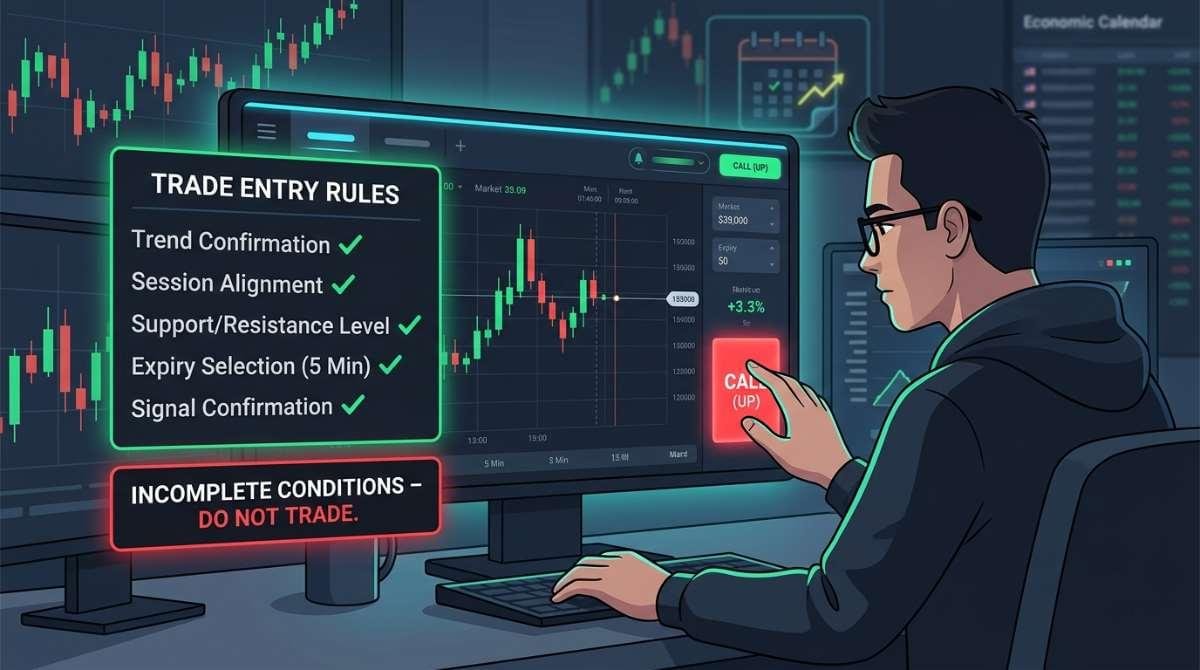
Enter only when your strategy’s full checklist is met. Skipping one condition because a trade “looks good” is how beginners accumulate random losses.
Apply Position Sizing

Risk no more than 2 % of your total account balance per trade. On a $500 account, that is $10 per trade. This rule alone keeps you in the game long enough to learn.
Record, Review, Repeat

Keep a trading journal. Log the asset, expiry, strategy used, entry reason, and outcome. Review weekly. Patterns in your losses reveal your actual weaknesses not the ones you imagine.
The 12 Best Binary Options Trading Strategies for Beginners (Updated 2026)
RSI Strategy (Best for Ranging Markets)
The Relative Strength Index (RSI) measures momentum on a 0–100 scale. Readings below 30 signal oversold conditions (price may bounce up); readings above 70 signal overbought conditions (price may reverse down).
Entry Rules
- Use a 14-period RSI on the 5-minute chart
- CALL (UP) trade: RSI crosses back above 30 from below + price is near a known support level
- PUT (DOWN) trade: RSI crosses back below 70 from above + price is near a known resistance level
- Expiry: 15 minutes
Why it works: RSI divergence — where price makes a new high but RSI does not — is one of the highest-probability reversal signals in technical analysis.
MACD Strategy (Best for Trend Confirmation)
The Moving Average Convergence Divergence (MACD) indicator shows the relationship between two EMAs (typically 12 and 26 period). The signal line (9-period EMA of MACD) triggers entries.
Entry Rules
- Set MACD (12, 26, 9) on a 5-minute chart
- CALL trade: MACD line crosses above signal line + histogram turns positive + price is above the 50 EMA
- PUT trade: MACD line crosses below signal line + histogram turns negative + price is below the 50 EMA
- Expiry: 15–30 minutes
Support and Resistance Strategy (Most Reliable for Beginners)
Support and resistance levels are price zones where the market has previously reversed. They work because thousands of traders place orders at the same levels — creating self-fulfilling momentum.
How to Draw Levels Correctly
- Use the 1-hour chart to identify major levels
- Mark zones where price reversed at least twice
- Use candlestick wicks, not just candle bodies, to define the zone
- The more times a level has been tested, the stronger it is
Entry Rules
- CALL trade: Price touches support zone + a bullish reversal candle forms (pin bar, engulfing)
- PUT trade: Price touches resistance zone + a bearish reversal candle forms
- Expiry: 15–30 minutes
Price Action Strategy (No Indicators Required)
Price action trading reads raw candlestick patterns to make decisions — no indicators needed. It is slower to learn but produces some of the cleanest setups.
Key Candlestick Patterns to Master First
- Pin Bar (Hammer / Shooting Star): Long wick shows rejection of a price level. A pin bar at support = strong CALL signal.
- Engulfing Candle: A candle that fully “engulfs” the previous candle signals a momentum shift.
- Doji: Indecision candle — most powerful when it appears at a key support/resistance level.
- Inside Bar: Consolidation before a breakout — trade the breakout direction.
Trend Following Strategy (Ride the Wave)
The oldest rule in trading: the trend is your friend. Trend-following strategies have a lower win rate but larger average wins — which suits digital options with higher payouts for larger moves.
Entry Rules
- Confirm uptrend: price makes higher highs and higher lows above the 50 EMA
- Wait for a pullback to the 50 EMA or a prior support level
- CALL trade: Bullish candle forms at the pullback level during an uptrend
- PUT trade: Bearish candle forms at the pullback level during a downtrend
- Expiry: 30 minutes to 1 hour
Breakout Strategy (Catch the Move Early)
Breakout trading captures the explosive price movement that follows a period of consolidation. The challenge is avoiding false breakouts — the most common beginner mistake.
Entry Rules
- Identify a consolidation range (price bouncing between two tight levels for 10+ candles)
- Wait for a candle to close outside the range — not just wick through it
- Enter on the next candle open after the breakout candle closes
- Confirm with rising volume (if your platform shows it)
- Expiry: equal to 2–3x the consolidation range width in candles
Scalping Strategy (1-Minute and 5-Minute Trades)
Scalping targets very short-term price movements with high trade frequency. It is the hardest strategy for beginners due to noise, emotional pressure, and the need for fast, disciplined execution. Only attempt scalping after 60+ hours of demo practice with another strategy.
Entry Rules (5-Minute Scalping)
- Use Bollinger Bands (20, 2) + RSI (14) on the 1-minute chart
- CALL trade: Price touches lower Bollinger Band + RSI below 30 + bullish reversal candle
- PUT trade: Price touches upper Bollinger Band + RSI above 70 + bearish reversal candle
- Expiry: 5 minutes
- Max 5 trades per session — stop after 3 consecutive losses
Trend Following Strategy (Trade With the Market, Not Against It)
The trend following strategy is one of the most reliable approaches in binary trading. It identifies the dominant direction of the market — up, down, or sideways — and places trades aligned with that direction rather than against it. The core principle: a trend in motion tends to stay in motion.
How to Identify a Trend
- Uptrend: Price consistently makes higher highs and higher lows; stays above the 20 EMA and 50 EMA
- Downtrend: Price makes lower highs and lower lows; stays below the 20 EMA and 50 EMA
- Use trend lines drawn across swing highs (downtrend) or swing lows (uptrend) to visualise the trend channel
Entry Rules
- CALL trade: Confirmed uptrend + price pulls back to the 20 EMA or trend line support + bullish candle closes
- PUT trade: Confirmed downtrend + price retraces to the 20 EMA or trend line resistance + bearish candle closes
- Expiry: 15–30 minutes on the 5-minute chart
- Never trade a trend following setup if price is more than 3 candles away from the EMA — the move is extended
Key tool: Moving averages (20 EMA and 50 EMA) are the backbone of trend following. When both slope in the same direction and price is on the correct side, the trend is clean and tradeable.
Pinocchio Strategy (Pin Bar Reversals)
The Pinocchio strategy named for the long candlestick “nose” that tells a lie about price direction — is a high-precision reversal technique. When price aggressively probes a level but is violently rejected, the resulting long-wick candle (pin bar) signals that the market has refused that price, and a sharp reversal is likely.
What a Valid Pin Bar Looks Like
- The wick (nose) is at least 2–3 times longer than the candle body
- The body closes near the opposite end of the candle (small body, long wick)
- A bearish pin bar has a long upper wick — price was pushed up and rejected
- A bullish pin bar has a long lower wick — price was pushed down and rejected
Entry Rules
- CALL trade: Bullish pin bar (long lower wick) forms at a key support level or trend line
- PUT trade: Bearish pin bar (long upper wick) forms at a key resistance level or trend line
- The pin bar must form at a meaningful price level — a pin bar in the middle of nowhere has no edge
- Expiry: 5–15 minutes (short-term reversal setup)
Why it works: The long wick represents trapped traders who entered in the wrong direction. As price reverses, those traders panic and exit — adding fuel to the move you are trading.
News Trading Strategy (Event-Driven Volatility)
The news trading strategy capitalises on the explosive price movements that follow major economic announcements. Interest rate decisions, Non-Farm Payrolls (NFP), inflation data (CPI), and corporate earnings releases all generate predictable volatility spikes that binary option traders can exploit.
How to Prepare for News Trades
- Use an economic calendar (Forex Factory, Investing.com) to identify high-impact events for the week
- Focus on Tier 1 events: central bank rate decisions, NFP, GDP, CPI
- Note the consensus forecast — the market has already priced this in
- The trade opportunity comes when the actual data deviates significantly from the forecast
Entry Rules
- CALL trade: Actual data is significantly better than forecast (e.g., jobs added far exceed expectations) + price direction confirms
- PUT trade: Actual data is significantly worse than forecast + price direction confirms
- Wait for the initial volatility spike to settle (15–30 seconds after release), then enter in the direction of the sustained move
- Expiry: 5–15 minutes
- Avoid trading 5 minutes before and during the release — spreads widen and fills are unpredictable
Caution: News trading is unsuitable for absolute beginners. Master at least one other strategy on a demo account first. Markets can reverse violently after the initial spike.
Range / Sideways Trading Strategy
When markets are not trending, they are ranging — price bounces between a horizontal support floor and a resistance ceiling. This is the ideal condition for the range trading strategy and occurs frequently during low-volatility sessions (e.g., Asian session for major forex pairs).
How to Confirm a Valid Range
- Price has touched both the support and resistance level at least twice each
- Both the 20 EMA and 50 EMA are flat (not sloping) — confirming no trend
- The range width is at least 20–30 pips for forex — narrow ranges produce too many false signals
Entry Rules
- CALL trade: Price touches the support zone + RSI is below 40 + a bullish reversal candlestick forms
- PUT trade: Price touches the resistance zone + RSI is above 60 + a bearish reversal candlestick forms
- Expiry: 10–15 minutes
- Exit the strategy immediately if a candle closes convincingly outside the range — a breakout has begun
Range trading pairs naturally with the support and resistance strategy. The difference is context: range trading is specifically applied in confirmed sideways market conditions, using both boundaries as active trade zones.
Moving Average Crossover Strategy
The moving average crossover strategy uses two moving averages of different lengths to generate trend-change signals. When the faster (shorter-period) MA crosses above the slower (longer-period) MA, it signals bullish momentum. A cross below signals bearish momentum. This is one of the most widely used technical signals in all of trading.
Recommended Settings for Binary Options
- Fast MA: 9-period EMA
- Slow MA: 21-period EMA
- Chart: 5-minute timeframe
- Optional confirmation: MACD histogram in the same direction as the crossover
Entry Rules
- CALL trade: 9 EMA crosses above 21 EMA + both EMAs are sloping upward + MACD histogram is positive
- PUT trade: 9 EMA crosses below 21 EMA + both EMAs are sloping downward + MACD histogram is negative
- Expiry: 15–30 minutes
- Do not enter crossover signals that occur during flat, sideways EMA conditions — these produce whipsaws
Advanced variation: The triple crossover uses 9, 21, and 50 EMAs. Entry is only triggered when all three are aligned in the correct order (9 above 21 above 50 for CALL; reverse for PUT) a higher-confidence but lower-frequency signal.
Key Considerations: What Every Strategy Depends On
No matter which of the 12 strategies above you choose, four fundamental principles determine whether it actually produces consistent results. Treat these as non-negotiable components of your trading plan.
Use Technical Indicators to Confirm
Indicators like RSI, Bollinger Bands, MACD, and moving averages do not predict the future. They describe what has already happened with price and momentum. Their value is in confirming a signal generated by price action or a key level — not in generating trades on their own. A single indicator flashing a signal is weak. Two or three indicators aligned with a price action signal at a key level is a high-probability setup.
Always Wait for Confirmation Before Entering
The single most common beginner mistake is entering a trade the moment price touches a level. Wait for confirmation: a candlestick close, an indicator cross, or a rejection wick that proves price is actually reversing. A few seconds of patience filters out the majority of false signals. The best traders are bored most of the time — they only move when everything aligns.
Practice Every Strategy on a Demo Account First
Every strategy in this guide should be run through a minimum of 50 demo trades before any real money is committed. The demo environment removes emotional pressure, allowing you to genuinely evaluate whether a strategy’s rules are clear, executable, and producing a positive result. When demo results are consistently profitable over three weeks, and only then, consider a small live deposit.
Risk Management Is Not Optional — It Is the Strategy
A profitable technical strategy with poor risk management still leads to account loss. The two work together: your entry strategy finds high-probability setups; your risk rules ensure one bad streak does not end your trading career. The 2 % per trade rule, combined with a daily 6 % loss limit and a firm no-Martingale policy, gives any solid strategy the space to work over the long run.
Risk Management
Every professional trader agrees: risk management keeps you alive long enough to profit. Technical strategies only work if you survive losing streaks — and losing streaks happen to everyone.
Core Risk Rules for Binary Options
- 2 % rule: Never risk more than 2 % of your account on a single trade
- Daily loss limit: Stop trading if you lose 6 % of your account in one day (3 losing trades at 2 % each)
- No revenge trading: After a loss, take a 30-minute break before the next trade
- No Martingale: Doubling your stake after a loss is mathematically dangerous in fixed-risk binary options
- Demo first: Achieve a positive result over at least 50 demo trades before trading real money
Trading Psychology
Surveys of retail traders consistently show that poor psychology not poor strategy causes most losses. Winning traders are not smarter; they are more disciplined.
The Four Mental Traps Beginners Fall Into
- Fear of missing out (FOMO): Chasing trades that have already moved. Solution: pre-define your setup and wait for it.
- Overconfidence after wins: Increasing position size after a winning streak. Solution: fixed position sizing always.
- Loss aversion: Holding losing positions hoping they recover. Solution: in binary options, the loss is fixed — accept it and move on.
- Confirmation bias: Seeing only signals that match your existing trade idea. Solution: go through your full checklist before entry, not after.
Using a Demo Account to Test Your Strategy
A demo trading account uses virtual money on real market data. It is the single most underused tool available to beginners. Treat it seriously:
- Use the same position sizes you plan to use on a live account
- Trade at the same times of day you plan to trade live
- Record every trade in a journal, screenshot entries and exits
- Run each strategy for a minimum of 50 trades before judging its effectiveness
- Only move to a live account when you have 3 consecutive profitable demo weeks
Common Beginner Mistakes to Avoid
- Trading without a strategy: “It looks like it might go up” is not a strategy
- Ignoring the trend: The most expensive mistake in technical trading
- Over-trading: More trades ≠ more profit. Quality over quantity
- Chasing losses: The fastest way to empty an account
- Skipping the demo: Real money amplifies every emotional mistake by 10x
- Using unregulated platforms: You can trade perfectly and still not get paid
- Following “signal providers” blindly: Most paid signal services are not independently verified
Final Verdict
A binary options trading strategy only delivers results when three components work together: a technically sound entry system, strict risk management that protects your capital during losing streaks, and the mental discipline to follow your rules when emotions push back. No indicator or signal service replaces these fundamentals.
Start with the support and resistance strategy on a demo account. Trade it for 50+ sessions. Journal everything. Only after consistent demo profits should you consider depositing real money, and only with a fully regulated, licensed broker whose credentials you have personally verified.
Frequently Asked Questions
The support and resistance strategy with candlestick confirmation is ideal. It’s simple, effective, and works across different assets and timeframes without complex indicators.
No, consistent 90% win rates are unrealistic. Most professional traders achieve around 55–70%. Focus on steady performance with proper risk management for long-term success.
Beginners should use 15-minute expiries. They reduce market noise compared to 1-minute trades while still offering enough trading opportunities during a session.
Yes, price action trading using support, resistance, and candlestick patterns can be effective without indicators. Many traders rely solely on these methods successfully.
You can start with $50 using proper risk management. Risk only 1–2% per trade and never invest more than you can afford to lose.
Practice at least 4–6 weeks and complete 50–100 trades. Ensure consistent profits before switching to a live account to reduce risk.